The Butterfly Clip A 45-minute read. Free every fifth Sunday.
A pink plastic butterfly hair clip arrives at a Marathon crime scene before the detective does. Dr. Elena Crowe recognizes it instantly. So does her sister, Detective Mara Crowe. Twenty years ago their mother disappeared wearing that same clip.
The package arrived at the crime scene before she did. Inside the clear evidence bag was a child’s pink hair clip, the plastic one with the cracked butterfly. Detective Mara Crowe held it up against the fading light and said, “Victim number three. Same as the others.” Dr. Elena Crowe didn’t answer. She was staring at the clip and counting the years. Twenty. Exactly twenty years since their mother had worn that same clip the morning she walked out and never came back.
It had come at ten after four, Mara said. A padded yellow mailer set on the cap of the seawall behind the house, no postage, no name. Deputy Ortiz found it walking the property line and had the sense to leave it where it sat until the crime scene tech photographed it in place, with a scale, from four angles. Then the tech slit it along the bottom seam with a scalpel so the flap and anything on the adhesive stayed intact.
Elena had been in the Keys less than five hours. She’d left her apartment in Miami at seven, taken the Turnpike to Florida City and the long two-lane run through the mangroves to Key Largo, then crawled behind a boat trailer from Tavernier to Islamorada. At the Fairfield Inn on the north end of Marathon, the clerk gave her a second-floor room over the parking lot. She dropped her suitcase on the luggage rack, lay down on top of the spread in her clothes, meaning to rest ten minutes, and woke forty minutes later with the air conditioner rattling and the room gone dim behind the blackout curtains.
She walked back down the hall at a normal speed, because the shape at the window could see her. She picked her keys up off the hook and her phone off the chair arm.
“We’re going to Beth’s,” she said.
“Okay.”
The okay came too fast. She heard it. She kept moving.
Out through the kitchen. The slider was sticky in the cold and she had to lift it on the track. The sound it made was enormous. Nothing came down the stairs.
The backyard was wet. Frost coming. The grass took their steps and gave them back as two sets of prints in the silver. Hers and a small one. She made herself not count the small one twice.
Fenner Street was over. 8:44. Porches dark. Folding chairs folded. A smashed pumpkin at the end of the Burkharts’ drive that somebody’s brother would get blamed for. Two doors up, Beth’s kitchen was lit like a stage.
Dana went through the gap in the hedge, across the patio, and knocked on the kitchen door with the side of her fist.
Nobody came.
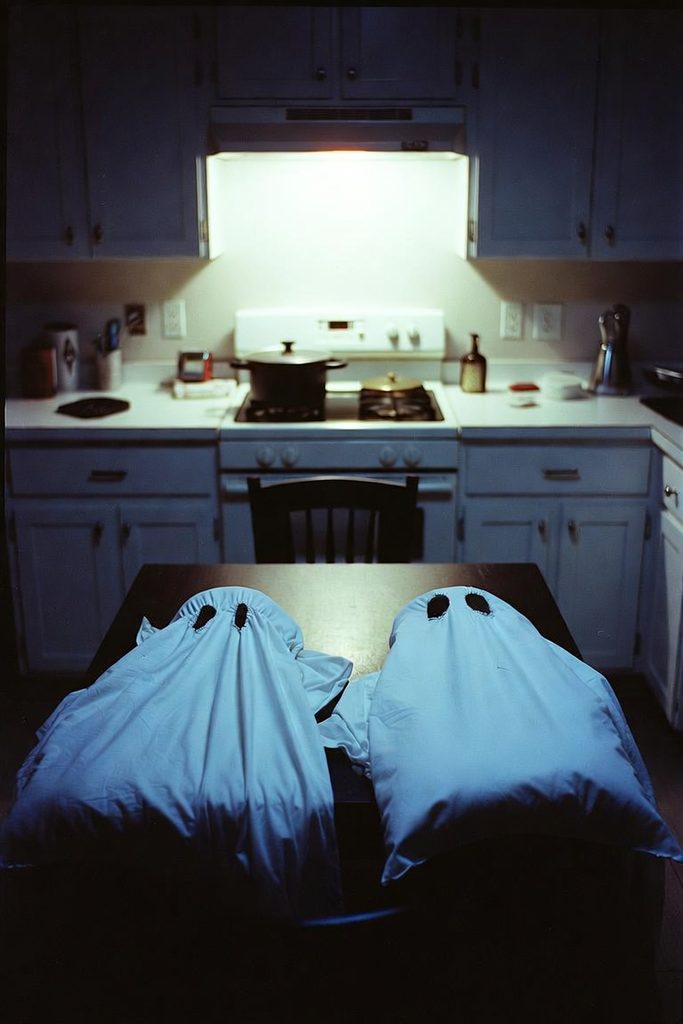
The kitchen was fully lit and fully empty. A pot on the stove with the burner off. Beth’s phone face-up on the counter, screen dark. The chair pushed back from the table at an angle, the way a chair is when somebody stands up mid-sentence.
On the table were two pillowcases.
Not folded. Not new. Cut. Two holes each. Elastic gathered at the throat in a knot that kept slipping, the exact repair Dana had made at her own counter with kitchen scissors nine minutes before six.
Empty. Flat. Laid out side by side like clothes somebody set out for the morning.
Dana stepped back off the patio.
She looked at her own house across two yards.
Her back door was open.
The slider she had lifted on its track and pulled shut behind her, all the way, she had felt it seat — it was standing open the width of a person. The kitchen light she had not turned on was on. The shape of her kitchen was the shape of a room with somebody in it.
“Car,” she said.
They went around the side, down the drive. She did not look at the front window as she passed it. She does not know, to this day, whether anything was at it.
She put the kid in the back and did the seatbelt herself because her hands needed a job. The pillowcase went on the seat. She got in front. Locked the doors. All four at once. That good hard sound. She started the engine and did not put on the headlights until the end of Fenner.
Route 9 was empty. Gas station. Dark bank. The drugstore sign still on.
She caught the red at Route 9 and Miller.
She sat with her foot on the brake and her hands at ten and two and made herself breathe out all the way, once, the way they teach you.
“You okay back there?”
“Yes.”
“We’re going to Grandma’s.”
“Okay.”
She checked the mirror.
The kid was sitting up straight against the seat back, hands in the lap, looking out the side window at the closed drugstore. Sneakers still on. Hair still flat with static.
Next to the kid, the pillowcase lay across the seat where she had dropped it, and the two holes cut in it were pointed at the mirror.
At her.
She had set it down folded, face into the seat.
A bedsheet cannot turn over.
The light went green.
Behind her, a car she hadn’t seen come up flashed its brights once, politely, the way you do.
Two ghosts on the porch. She brought one home. At 8:06 something walked the upstairs hall while her kid sat downstairs eating Smarties.
She did not go up.
Every part of her body wanted to. That is what the stairs are for. That is what a mother does. You go up and you turn on the light and there is a coat over a chair and you feel stupid for a week and you tell it at Thanksgiving.
She did not go up, because if she went up she would be on the stairs, and whatever was on the second floor would be between her and Sam, and Sam would be alone on the first floor with the front door.
She moved the armchair instead.
She dragged it out of the corner and set it at the mouth of the hallway, at the one spot in the house where she could see the bottom of the stairs and the front door at the same time. It took four seconds. She had never thought about that spot in three years of living there. She found it immediately.
“Sit with me,” she said.
“I’m sorting.”
“Bring it.”
Sam brought the piles over, which meant carrying them in the pillowcase, which meant unsorting them, which meant a fight about it. Dana let that be the thing they were doing. She sat on the arm of the chair with her feet on the floor and her eyes on the stairs.
8:19.
The trick-or-treating on the street was thinning. She could hear it going the way a party goes. Voices farther apart. A car door. Somebody’s mother calling a name twice.
Nothing else walked upstairs.
She counted the landing spindles. Eleven. She counted them again to make sure she got eleven.
“Mom.”
“Yeah.”
“Can I take my shoes off now.”
“No.”
Sam thought about arguing and didn’t. That worried her more than the arguing would have.
The knock came at 8:31.
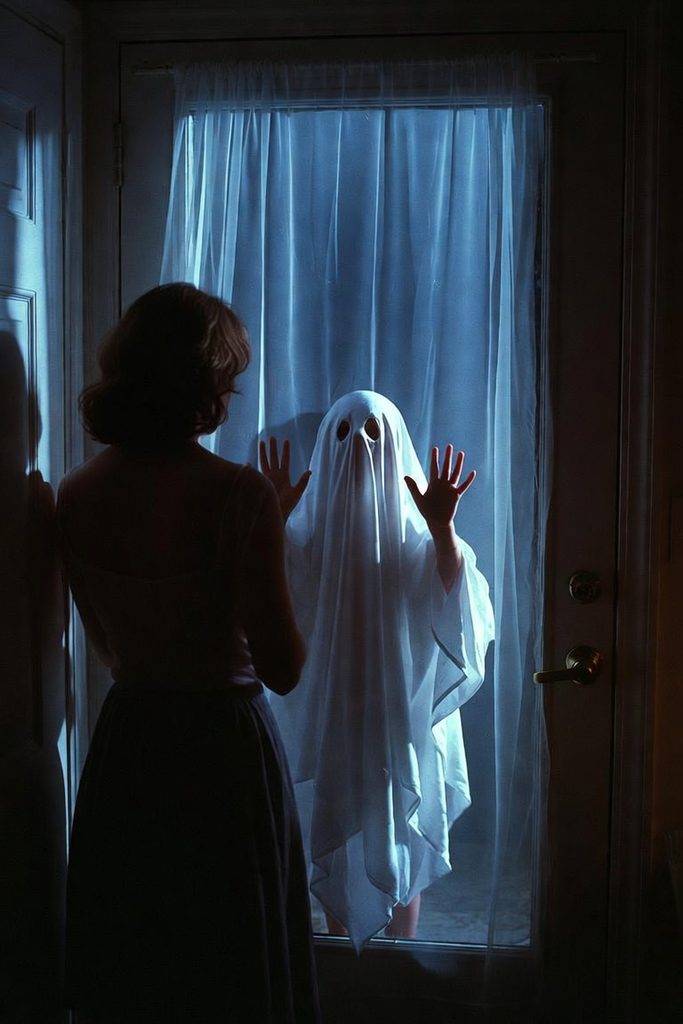
Not on the door. On the glass. The long window beside the door, the one with the sheer over it. Three taps at the height of a child’s shoulder. Tap. Tap. Tap. Patient. The rhythm of somebody who has been taught how to knock and is doing it properly.
Dana stood up.
Through the sheer there was a white shape. The line of the top of the head. The soft fall of the fabric. Nothing else. The porch light was off. She had never turned it on. She had never put a bowl out. This had never been a house that got trick-or-treaters, and she had liked that about it.
The shape stayed at the window.
It did not go to the door. It did not try the knob. It stood at the glass where it could be seen and waited to be let in, and that was worse than the knob would have been. The knob is a thing you fight. This was a thing you answer.
“Mom.”
“Stay in the chair.”
Tap. Tap. Tap.
Dana went to the door. Not to open it. She put her hand on the frame beside the window and looked at the deadbolt, which was thrown, and the chain, which was on, and she counted those the way she had counted the spindles.
“Go home,” she said through the glass.
The shape didn’t move.
“I’m going to call your mom. Tell me your house number.”
Nothing. The fabric stirred a little at the bottom. There was wind, so the fabric could stir.
Behind her, from the chair, Sam said, “That’s me.”
Dana turned around.
Sam was kneeling up on the seat cushion with both hands on the back of the chair, looking down the hall at the window. Completely calm. Not scared. Interested, the way kids are interested in a thing that belongs to them.
“That’s me,” Sam said again. “I forgot my shoes.”
The lamp was on in the living room. Dana could see the whole length of her child in it. Jeans. The pillowcase bunched at the waist where it had been pulled up. And on the feet, laced, both of them, still knotted the way Dana had knotted them at 6:39 in the hallway because they were running late.
Sneakers.
“You have your shoes on,” Dana said.
Sam looked down at them.
Looked at them for a long time. Longer than a kid looks at their own feet.
“I know,” Sam said.
Tap. Tap. Tap.
Dana’s phone was on the arm of the chair, three feet from her kid. Getting it meant walking away from the door. Walking away from the door meant nobody was at the door.
Through the sheer, the white shape lifted one arm. Slow. Level with the glass.
Then the other one.
Both hands flat on the window, the way a kid does at an aquarium.
And a voice came through it, breathy and pitched right and perfectly polite, the voice of a seven-year-old being good for an adult:
Two ghosts on a porch on Fenner Street. Same pillowcase, same height. One of them knew Dana’s name. She took the one that wasn’t wearing the bracelet, because a bracelet is a thing anybody can slide off a wrist, and she wanted the kid, not the plastic.
She got them to the sidewalk without running.
Running would have made it a thing. Running would have told the street, and the street was full of people she had to see at pickup on Monday. So she walked, fast, one hand around a small wrist, and she did not look back at 27 until they were past the hedge.
The porch light at 27 went out.
Not a flicker. Not a bulb. It went out the way a light goes out when someone inside puts their hand on the switch, and the cauldron sat there in the dark with its sign still readable, TAKE 2 PLEASE, and the storm door did not open.
“Ow,” the ghost said. “You’re squeezing.”
She loosened her hand. She did not let go.
“We’re going home.”
“We’re not done.”
“We’re done.”
They went down Fenner with the flashers of a crawling minivan sliding over them. At the corner Sam pulled the pillowcase off the head because the mouth hole had gone crooked, and it was Sam’s face, hair stuck flat with static, mouth open in the specific unhappy way Dana had been looking at since the delivery room.
She felt her ribs come down.
“Can we do Barrow Street?”
“Next year.”
At home she put the chain on. She had never once put the chain on.
7:52 by the microwave.
Sam dumped the bag on the living room rug, which was the whole point of the night, and Dana sat on the arm of the couch and watched candy come out of a pillowcase.
There was too much of it.
She had counted. Not on purpose — she’d counted the way you count a kid’s houses, four at Pellerin’s, two at 15, the Reese’s
always gave the full-size, the Burkharts did pretzels. Eleven houses. Maybe thirty pieces. She’d stood at the mailbox and watched every hand go into every bowl.
There was easily twice that on the rug.
Butterfingers. Smarties. A roll of Necco wafers, which she had not seen in a store in a decade. Three of the toothbrushes.
“Where’d you get all this?”
Sam was sorting. Chocolate here, fruit here, garbage here.
“Houses,” Sam said.
“Which houses?”
“All of them.”
Dana picked up a Necco roll. The wrapper was soft, the paper gone furry the way paper gets when it’s been in a drawer.
She got up and went to the front window to pull the curtain.
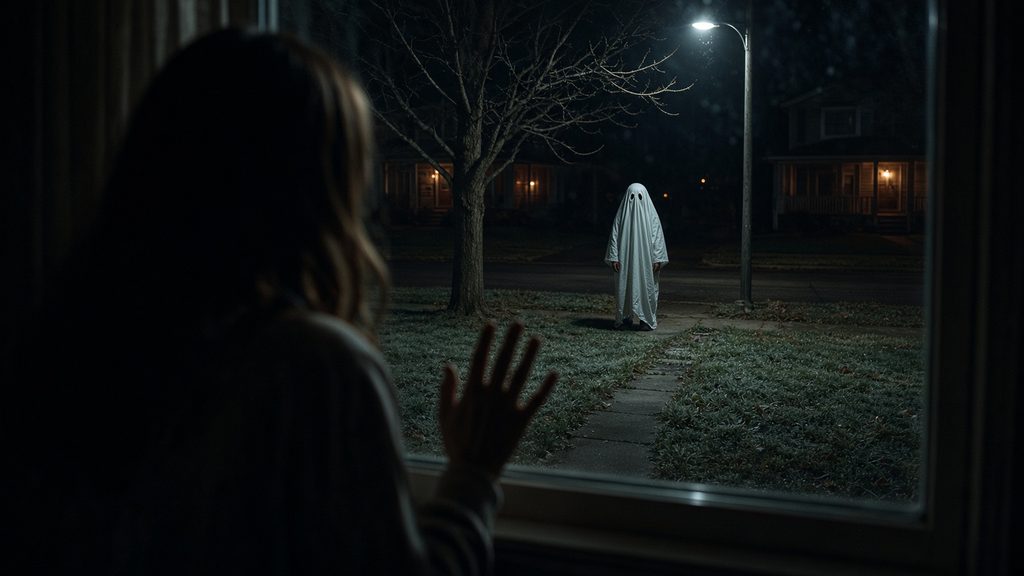
There was a ghost in the yard.
It stood on the grass between the maple and the walk, in the dead spot the streetlight didn’t reach. Same white. Same two holes. Arms down. It was not doing anything. It was the stillness of a kid who has been told to wait in one place and takes it seriously.
Dana put her hand flat on the glass and then took it off, because it left a print.
“Sam. Stay right there.”
“I am right here.”
She got her phone off the counter. Her thumb was not steady. She opened the thread with Beth from two doors up, the one that was mostly sign-up sheets and a photo of somebody’s lost cat.
Dana: Is Ellis out tonight?
Dana: Weird question. Sorry.
The three dots came up right away. Beth was always on her phone. That was the one thing Dana had ever felt superior about and she was grateful for it now.
Beth: We stayed in. He’s got the ear thing again.
Beth: We didn’t see you. We thought you stayed in.
Dana read it twice.
Dana: We were out at 6:40. We did your side.
Beth: Our light was off, hon. We’ve been on the couch since 5.
Dana went back to the window.
The yard was empty.
Not walking-away empty. Empty like nothing had been standing there, grass flat, the maple shadow doing what maple shadows do. She looked at the dead spot until her eyes made shapes in it, which is what eyes do.
She pulled the curtain. Then she went around the first floor and pulled all of them, and she checked the back slider and the side door off the laundry, and both were locked, and she checked them again on the way back because checking once is not a thing that stays checked.
Sam was still on the rug. The sorting had gotten serious. There were four piles now, and one of them was just the Neccos.
“Mom. Can I have one.”
“Two.”
“Three.”
“Two.”
Sam took three. Dana let it go.
She sat down on the floor with her back against the couch so she could see the front door, and she put her phone facedown on her knee, and she breathed.
The furnace clicked on. The dishwasher, which she’d started before they left, hit the part of its cycle where it knocked. Ordinary house. Ordinary sounds. She made herself name each one.
Upstairs, somebody walked across the hall.
Small steps. Heel first, the way kids walk when they’re not being careful. From the landing toward the bathroom, four or five of them, over the loose board outside Sam’s room that she had been asking about since they moved in.
The sound stopped above her head.
Dana did not move.
On the rug, three feet in front of her, Sam unwrapped a Smartie and said, “That’s not me.”
The costume took nine minutes and kitchen scissors. Pillowcase. Two holes. A knot of elastic at the neck so it wouldn’t slide.
Sam wanted it that way. No cape. No store bag. No light-up anything.
“Ghosts don’t have shoes,” Sam said at the door.
“This one does. It’s forty-one degrees.”
Dana got the sneakers on. She snapped a glow bracelet around the wrist because a white sheet vanished against a white porch, and the bracelet was the only thing she could think of that wouldn’t ruin it.
They started at 6:40 at the top of Fenner Street.
It was the good kind of Halloween. Dry. Every third house had a bowl out, a folding chair, somebody’s dad holding a beer he wasn’t drinking. Cars crawled with their flashers on. Two older boys ran past in inflatable dinosaurs. The compressors sounded like a window fan.
Sam held Dana’s hand to the bottom of each driveway and let go for the walk to the porch. That was the deal. Dana stood at the mailbox and counted.
Four houses in, the pillowcase came back with three mini Snickers and a toothbrush.
“Somebody gave me a toothbrush.”
“Dr. Pellerin does that every year.”
“Why?”
“Because he’s a dentist and he thinks it’s funny.”
They took the odd side first. 11. 15. 19.
At 23 the motion skeleton lunged. Sam screamed, then laughed with the scream still in it. Dana felt the night settle into the shape she had wanted since September, the shape she had been dreading without a reason she could say out loud.
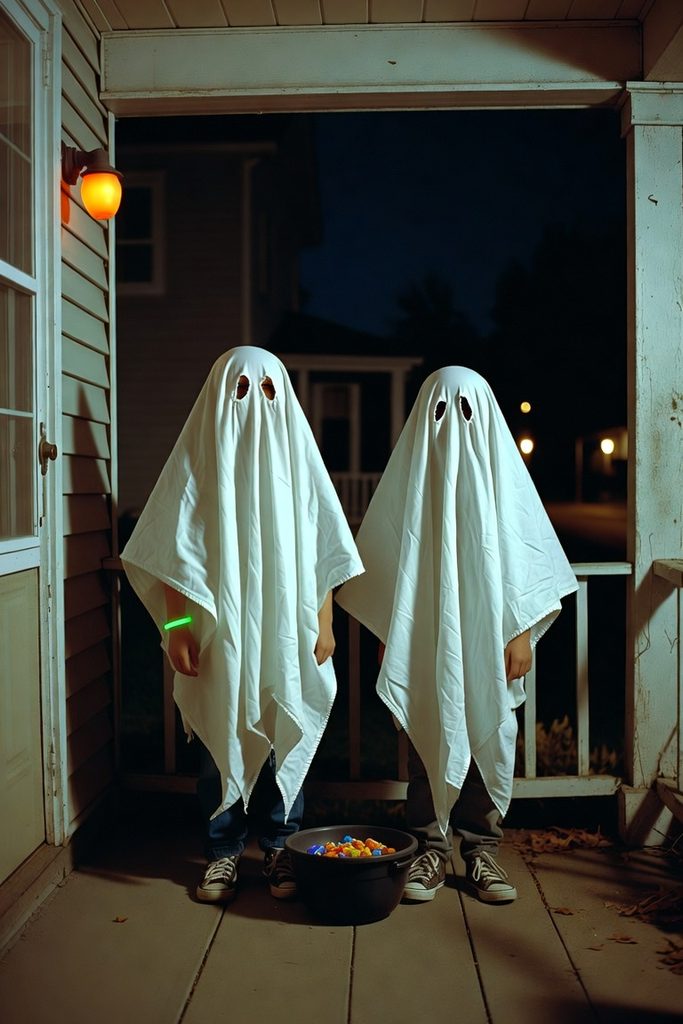
At 27 there was a second ghost on the porch.
She saw it from the sidewalk. Same white. Same two holes. Same elastic gather at the throat.
That was the part that stopped her. She had made that gather herself, standing at the kitchen counter, because the knot kept slipping.
The other ghost was Sam’s height. Exactly Sam’s height.
Dana looked down. Her hand was empty.
Sam was already halfway up the walk.
“Sam.”
Not loud. She would not be the mother who yelled on a stranger’s lawn.
The porch at 27 belonged to the Kestlers, who hadn’t lived there in two years. Somebody had bought it in the spring. Dana had never met them. The porch light was on. A plastic cauldron sat by the door with a sign that said TAKE 2 PLEASE. Nobody sat out.
Both ghosts were at the cauldron now.
Same size. Same stance. Weight on one leg. Pillowcase hanging in the same soft line. One had a glow bracelet.
She made herself look at the bracelet and keep looking at it.
The bracelet one bent for the candy.
The other one turned its head toward the street.
“Hi, Dana,” it said.
Kids on this block called her Sam’s mom. Some of them called her Ms. Halloway. Not one of them had ever called her Dana. She was thirty-six. None of them were.
The voice was a kid’s voice. That was the worst part. Pitched right. A little breathy through the fabric. The sound a seven-year-old makes when they’re being polite to an adult and want to get it over with.
“Who’s that?” Dana said.
Both ghosts had a hand in the cauldron.
“We’re almost done,” the one on the right said.
“Sam, come here.”
Neither of them moved.
The dinosaur boys went by behind her, compressors humming. One shouted something. The other shouted it back. Dana did not turn around.
“Sam. Now.”
Both ghosts straightened up at the same time.
That was when she understood she had been tracking the bracelet, and the porch was lying to her. Orange party bulb. Green plastic. Green under orange turned into a gray smear on a white sheet. They had both moved. They had crossed. She had not been looking at the wrist for four seconds. Maybe six.
Her legs took her up the walk.
Up close they smelled like her own dryer sheets. Both of them.
“Ghosts don’t have shoes,” one said.
They were both wearing sneakers.
She crouched. The porch boards gave under her knee. Through the eye holes there was only dark and the shine of something moving, and she thought, I know my kid’s eyes, and then she thought, I have never once looked at them in a hole in a bedsheet in orange light.
Behind her, the storm door of 27 stayed shut. Nobody came out to laugh and explain.
“Whose mom am I?” Dana said.
“You’re Dana,” the one on the left said.
“You’re Mom,” the one on the right said.
Sam called her Mom. Sam had always called her Mom.
She heard how easy that was to know from the outside.
One of them held out a hand. The sleeve of the pillowcase fell back. A glow bracelet. Green. Ordinary. A dollar for ten at the drugstore on Route 9.
The other one held out a hand too.
No bracelet.
Dana took the wrist without it.
Behind her, the one with the bracelet said, very softly, the way Sam said it when she didn’t want anyone else to hear:
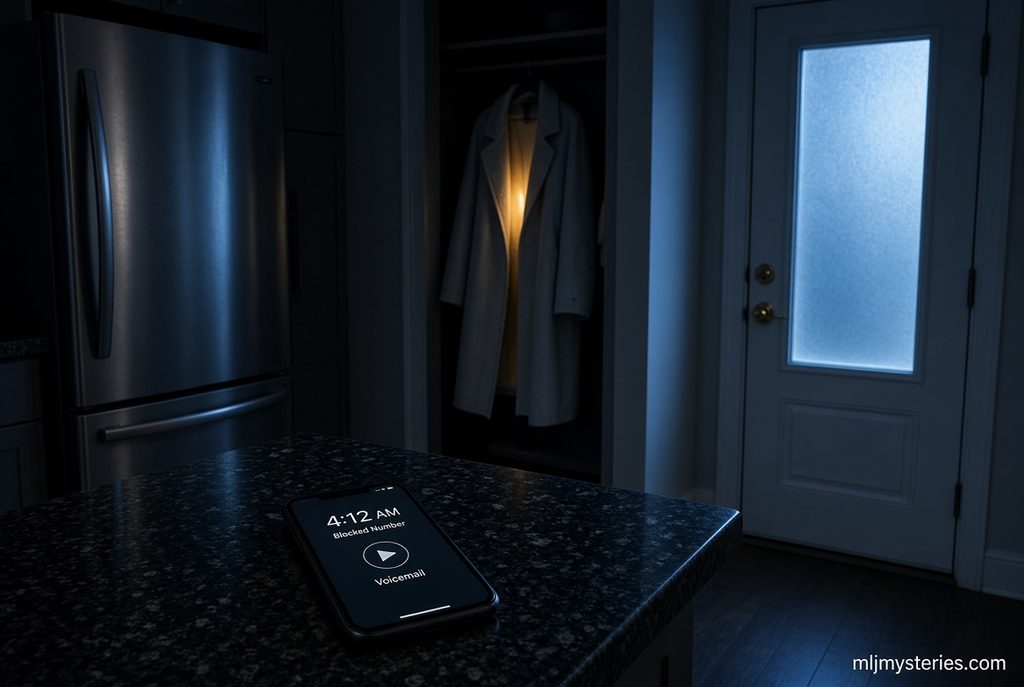
Blocked number. Lock-screen glow on the ceiling. Tess told herself it was a robocall — forty seconds of a call center breathing — and played it, anyway.
“Hey. Sorry. Did you lock the back door?”
Her voice. The pause after sorry. The upward hitch she hated on recordings.
“I think I left it open. Can you check?”
Under the words, a low hum, stuttering every few seconds. The kitchen refrigerator had done that since June.
Four minutes. The dark took all of them.
She took the stairs without lights. Four-in-the-morning cold. At the bottom, she stopped and listened. The fridge hummed. Caught. Hummed.
Mudroom. Glass panel. Gray yard. Hand on the knob, then the deadbolt.
Horizontal. Open.
Front, back, slider. Same order every night. Alone meant that order. The bolt went home too loud.
Locking it only mattered if whoever it was was still outside.
Phone flashlight low. Thumb on emergency call.
Living room: laptop closed, cord over the couch arm. Dining room: mail still fanned on the table. Office: camera on the shelf. Bedroom: wallet, keys, her mother’s ring in the dish.
Nothing taken. No gap. She kept waiting for the hole where something should have been. It never came. That was worse. Someone had come in and wanted none of it.
Coat closet last. The unused one by the front door.
She opened it fast.
Coats.
She pushed them apart for the back wall. Palm flat on the long gray wool. Stopped.
Warm. Not room-warm. Body-warm, leaving the fabric while she stood there, the way a chair is warm when someone has just stood up.
She shut the door. Backed into the hall. Turned a slow circle.
Empty. Every room she had already walked was empty.
Callback before anyone else. Blocked number. Three menus. Thumb missed twice.
Connect.
No ring. Open line. The dead air of a call that has gone somewhere.
“Hello.”
Nothing.
“I know you’re there.”
Not silence. Silence is flat. This had a shape: air, the press of a room holding still.
Her hands were not steady when she hung up.
She played it from the top. The first thirty seconds were all she had heard. Three and a half minutes had been sitting there the whole time she walked the house in the dark.
Door. Hum. Catch.
Then two minutes of a room with a refrigerator in it. Her kitchen. Nobody speaking.
At 3:42 her voice came back.
“Helen.”
Soft. The way you say a name to someone asleep in the next room. She had never known a Helen. Not a neighbor. Not a teacher. Not a woman on any list she had ever been on.
Her mouth. That name.
Then the click.
Not a dropped call. A handset set down on a hard surface, close to the mic — that small plastic knock — and under it half a breath of a room with someone in it.
The message ended.
She looked at the ceiling, at the floor above her, and did not go up.
Keys only. Front door pulled to and left unlocked. Locking it meant standing with her back to the glass.
Four bricks. Driveway. Black sky. Dew milky on the windshield.
Halfway down, she looked back.
The kitchen window over the sink was a pale rectangle of interior dark. A shape crossed it.
Not a curtain. Not a tree on the glass. Someone walking a room they knew. Unhurried. Not going anywhere in particular.
It did not stop. It did not look out.
She did not run. Running is a sound. Getting to the car took a year. The lock button under her thumb was the best noise of her life. All four at once.
Phone in the cradle. Both hands.
Blocked. 4:12 a.m.
Length: 3:50.
It had been four minutes. She had watched the bar crawl. Helen at 3:42. The click. The room after that.
She pressed play.
The door. The hum. The catch. Two long minutes of her kitchen with nobody in it.
“Helen.”
The handset going down on something hard.
3:50. Nothing after.
The screen went back to the list. One message. Blocked. 3:50.
Inside, past the pale rectangle, the fridge would still be catching and humming and catching, the way it had since June, into a room she was no longer standing in.
She reversed with the headlights off.
At the end of the street, she turned them on and drove.
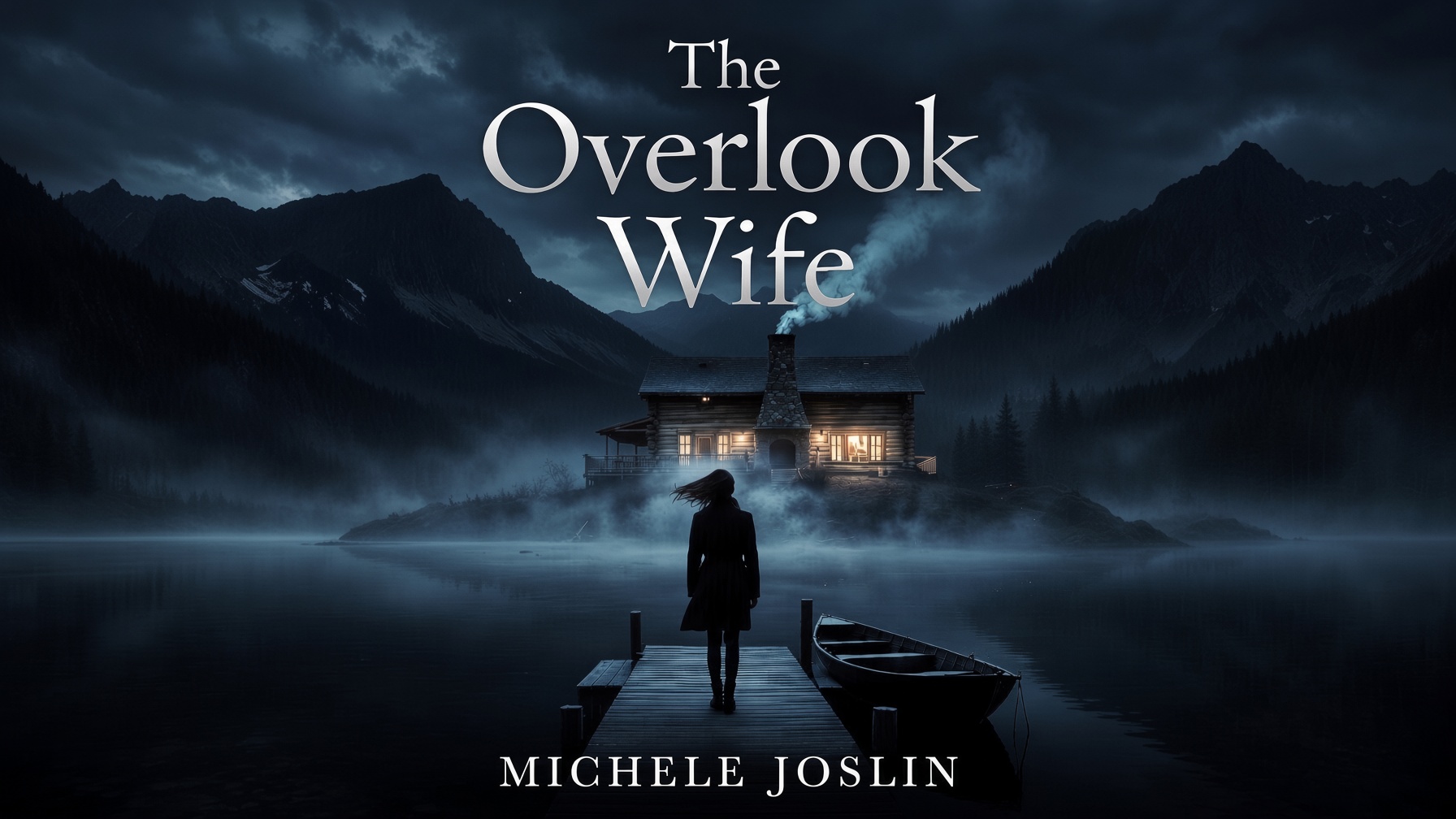
That line sits at the center of The Overlook Wife, my debut psychological thriller under the MLJ Mysteries imprint. The novel follows Rena, a woman who drives a thousand miles to disappear, only to find that the quiet Adirondack town and the man she begins to trust may be far more dangerous than the life she left behind.
I am currently providing advance digital copies to established reviewers, book bloggers, and serious readers of psychological thrillers who are interested in leaving an honest review on Amazon.
If that describes you, you are welcome to request a copy through BookSirens:
The Overlook Wife is the first title from MLJ Mysteries. Additional projects are already in development. This blog will continue to share updates, sample chapters, and publication news as new books approach.