Four Minutes
Michele Joslin
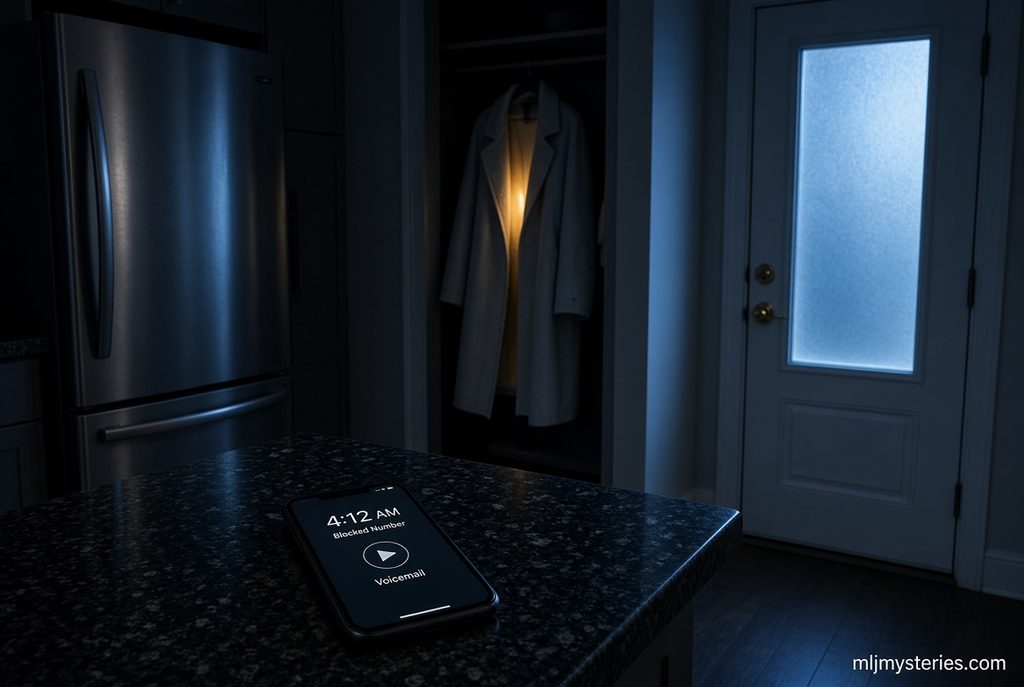
The voicemail hit at 4:12 a.m.
Blocked number. Lock-screen glow on the ceiling. Tess told herself it was a robocall — forty seconds of a call center breathing — and played it, anyway.
“Hey. Sorry. Did you lock the back door?”
Her voice. The pause after sorry. The upward hitch she hated on recordings.
“I think I left it open. Can you check?”
Under the words, a low hum, stuttering every few seconds. The kitchen refrigerator had done that since June.
Four minutes. The dark took all of them.
She took the stairs without lights. Four-in-the-morning cold. At the bottom, she stopped and listened. The fridge hummed. Caught. Hummed.
Mudroom. Glass panel. Gray yard. Hand on the knob, then the deadbolt.
Horizontal. Open.
Front, back, slider. Same order every night. Alone meant that order. The bolt went home too loud.
Locking it only mattered if whoever it was was still outside.
Phone flashlight low. Thumb on emergency call.
Living room: laptop closed, cord over the couch arm. Dining room: mail still fanned on the table. Office: camera on the shelf. Bedroom: wallet, keys, her mother’s ring in the dish.
Nothing taken. No gap. She kept waiting for the hole where something should have been. It never came. That was worse. Someone had come in and wanted none of it.
Coat closet last. The unused one by the front door.
She opened it fast.
Coats.
She pushed them apart for the back wall. Palm flat on the long gray wool. Stopped.
Warm. Not room-warm. Body-warm, leaving the fabric while she stood there, the way a chair is warm when someone has just stood up.
She shut the door. Backed into the hall. Turned a slow circle.
Empty. Every room she had already walked was empty.
Callback before anyone else. Blocked number. Three menus. Thumb missed twice.
Connect.
No ring. Open line. The dead air of a call that has gone somewhere.
“Hello.”
Nothing.
“I know you’re there.”
Not silence. Silence is flat. This had a shape: air, the press of a room holding still.
Her hands were not steady when she hung up.
She played it from the top. The first thirty seconds were all she had heard. Three and a half minutes had been sitting there the whole time she walked the house in the dark.
Door. Hum. Catch.
Then two minutes of a room with a refrigerator in it. Her kitchen. Nobody speaking.
At 3:42 her voice came back.
“Helen.”
Soft. The way you say a name to someone asleep in the next room. She had never known a Helen. Not a neighbor. Not a teacher. Not a woman on any list she had ever been on.
Her mouth. That name.
Then the click.
Not a dropped call. A handset set down on a hard surface, close to the mic — that small plastic knock — and under it half a breath of a room with someone in it.
The message ended.
She looked at the ceiling, at the floor above her, and did not go up.
Keys only. Front door pulled to and left unlocked. Locking it meant standing with her back to the glass.
Four bricks. Driveway. Black sky. Dew milky on the windshield.
Halfway down, she looked back.
The kitchen window over the sink was a pale rectangle of interior dark. A shape crossed it.
Not a curtain. Not a tree on the glass. Someone walking a room they knew. Unhurried. Not going anywhere in particular.
It did not stop. It did not look out.
She did not run. Running is a sound. Getting to the car took a year. The lock button under her thumb was the best noise of her life. All four at once.
Phone in the cradle. Both hands.
Blocked. 4:12 a.m.
Length: 3:50.
It had been four minutes. She had watched the bar crawl. Helen at 3:42. The click. The room after that.
She pressed play.
The door. The hum. The catch. Two long minutes of her kitchen with nobody in it.
“Helen.”
The handset going down on something hard.
3:50. Nothing after.
The screen went back to the list. One message. Blocked. 3:50.
Inside, past the pale rectangle, the fridge would still be catching and humming and catching, the way it had since June, into a room she was no longer standing in.
She reversed with the headlights off.
At the end of the street, she turned them on and drove.
Need more than four minutes?
*The Overlook Wife* — Michele Joslin
Leave a Reply